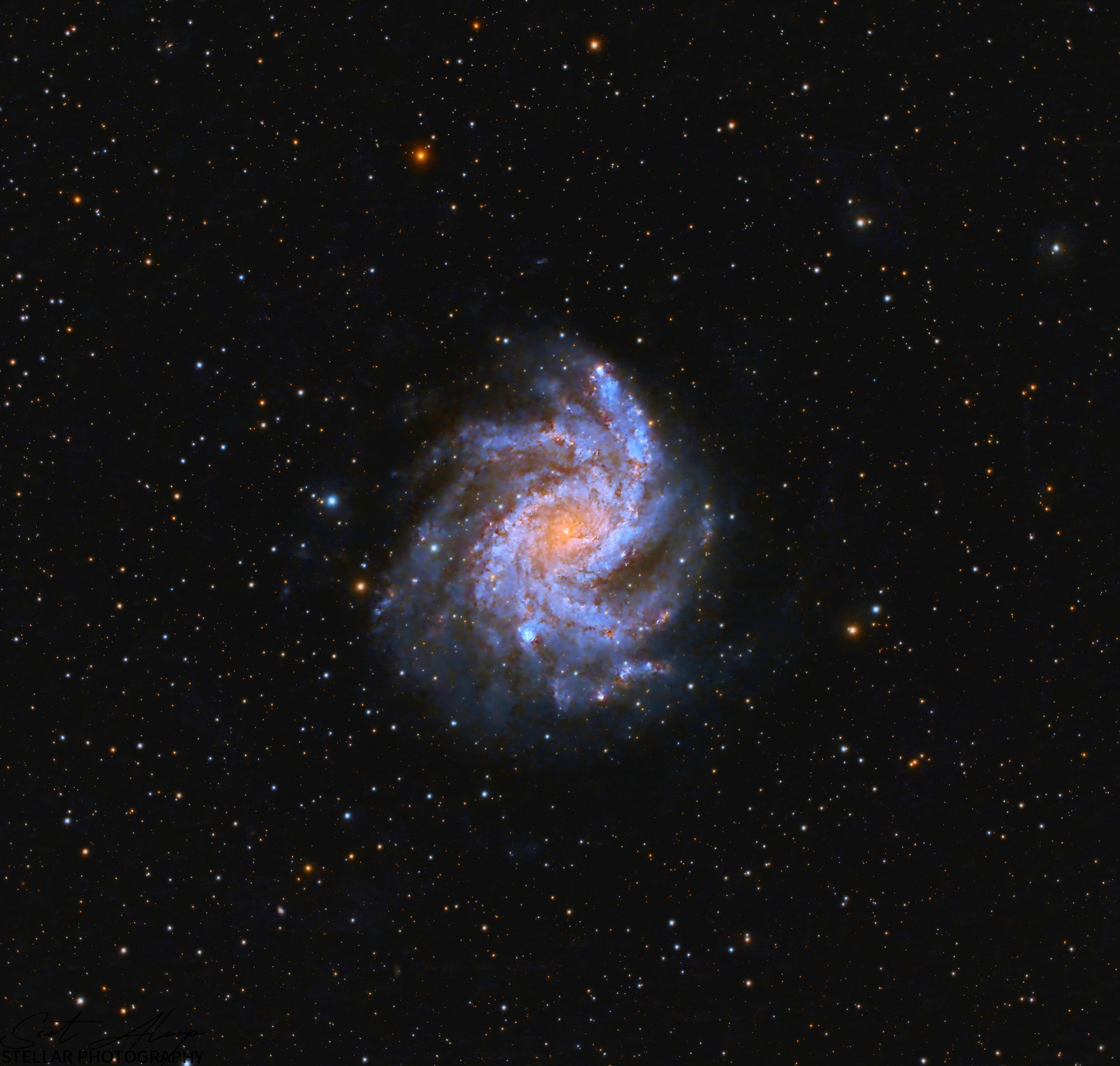

The Fireworks Galaxy is a face-on intermediate spiral galaxy with a small bright nucleus, whose location in the sky straddles the boundary between the northern constellations of Cepheus and Cygnus. At a distance of 25.2 million light-years from Earth, it was discovered in 1798 by William Herschel. This galaxy has a diameter of approximately 40,000 light-years, about one-third of the Milky Way's size, and it contains roughly half the number of stars as the Milky Way. It is called the Fireworks Galaxy due to it's rate of Supernova's detected is about twice that we would expect from a galaxy that size. It is heavily obscured by interstellar matter due to its location close to the galactic plane of the Milky Way. Due to its prodigious star formation it has been classified as an active starburst galaxy.